

Working Principle of a Screw Compressor
Aug. 08, 2025
When choosing the right rotary screw air compressor, it’s essential to understand its operating principles and the different types available. This comprehensive guide will explain how screw compressors work and help you determine why they could be the ideal solution for your specific requirements.
What is a rotary screw air compressor?
A rotary screw air compressor is one of the two main types of positive displacement gas compressors. It operates using two intermeshing rotors to generate the pressure required for air compression. Known for their ease of use and low maintenance, rotary screw compressors are a popular choice across many industries.
The other type of positive displacement compressor is the reciprocating, or piston, compressor.
In contrast, dynamic compressors—such as centrifugal compressors—use rotating impellers or radial blades to accelerate and discharge air, rather than trapping and compressing it mechanically.
How does a screw compressor work?
A screw compressor operates with a pair of rotors—one male and one female—rotating in opposite directions. As they turn, air is drawn into the space between the rotors and the housing. This space gradually decreases, compressing the air, which is then discharged through the outlet.
Each screw element has a fixed, built-in pressure ratio determined by the length and pitch of the rotors, as well as the design of the discharge port. For maximum efficiency, this pressure ratio should be matched to the required working pressure.
Rotor speed is carefully optimized to reduce both mechanical losses (caused by excess heat at very high speeds) and volumetric losses (air leakage at very low speeds).
Types of Screw Compressors
Rotary screw air compressors come in two main types:
Oil-Free (Dry) Screw Compressors
Oil-Lubricated Screw Compressors
Oil-Lubricated Screw Compressors
In oil-lubricated designs, the male rotor directly drives the female rotor. Oil is injected into the compression chamber to cool and lubricate the rotors, reduce leakage, and remove heat. This type of compressor can be built for high pressure ratios, often achieving up to 14 bar—and in some cases 17 bar—with a single compression stage, though this may reduce energy efficiency.
Oil-Free Screw Compressors
In oil-free technology, both rotors are driven by a timing gear to maintain precise synchronization, ensuring minimal clearance between elements. Because the rotors do not contact each other or the housing, no oil is required in the compression chamber, producing completely oil-free air.
Modern oil-free screw compressors often feature asymmetric rotor profiles to reduce internal leakage and improve efficiency. The built-in pressure ratio is limited by the maximum allowable temperature difference between inlet and discharge, so these compressors often operate in multiple stages with interstage cooling to achieve higher pressures.
Speed Variants
Screw compressors are also available in two operational variants:
Fixed-Speed Compressors – A fixed-speed screw air compressor operates at a constant speed, regardless of the air demand. This means it either runs at full capacity or is switched off. It's most efficient when used in applications with consistent and predictable air usage, where the compressor runs near 100% capacity for extended periods. Operate at a constant speed, delivering maximum output continuously. While efficient at full capacity, they waste energy when demand is lower, as the motor keeps running even when no air is produced. This inefficiency is especially noticeable in facilities with fluctuating air demand.
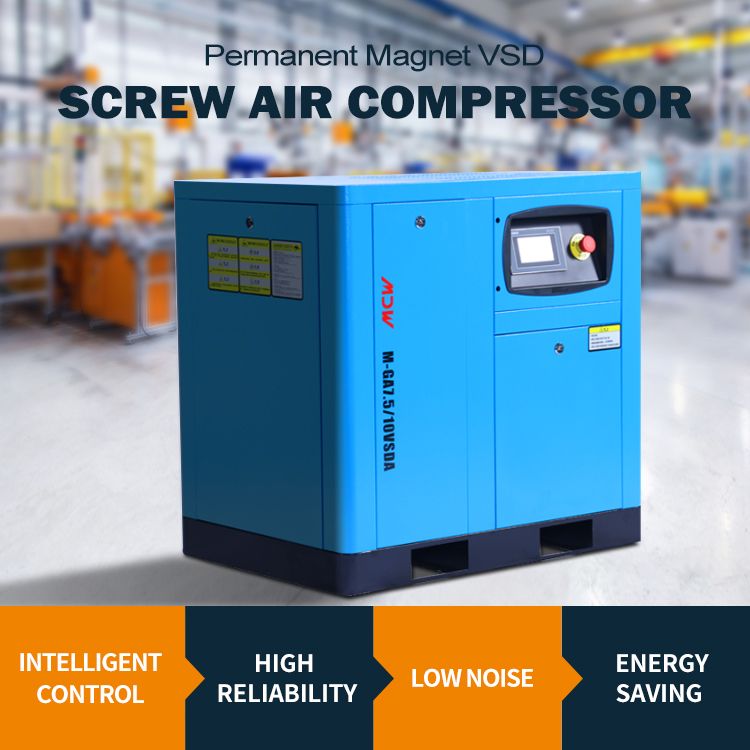
Variable Speed Drive (VSD) Compressors – Adjust the motor speed to match real-time air demand. When demand rises, the motor speeds up; when demand falls, it slows down, using only the energy required. VSD technology is particularly effective during low-production periods, shift changes, or partial-load operations—reducing electricity costs significantly.
Efficiency Considerations
Since over 80% of an air compressor’s lifetime cost comes from energy consumption, choosing the right type—oil-free or oil-lubricated, fixed-speed or VSD—is essential for maximizing efficiency and minimizing operating expenses.
Screw Compressors: A Solution for Every Application
One reason rotary screw compressors are so popular is their versatility—there’s a model for virtually every application. Atlas Copco offers screw compressors with three drive types, each offering unique benefits:
Belt Drive – Robust, easy to install, and simple to maintain. These compressors have the lowest initial investment cost, making them ideal for smaller operations.
Gear Drive – Quieter than belt-driven models and more energy-efficient. Although the upfront cost is higher, frequent use will quickly offset the investment through energy savings.
Direct Drive – The pinnacle of rotary compressor technology, offering unmatched efficiency and performance. Direct drive models are the quietest of the three and are available in designs ranging from basic models for smaller applications to ultra-efficient variable speed drive (VSD) versions.
Screw Compressors for Heavy-Duty Applications
For heavy-duty operations that run continuously—such as factories, industrial plants, and workshops—rotary screw air compressors are a smart upgrade.
Industrial benefits include:
Reliable 24/7 operation
High flow capacity with effective heat dissipation
Quieter operation compared to piston compressors
Reduced wear and tear
Compact footprint
Superior efficiency over piston compressors at around 15 kW (20 hp) and above
Lower oil carryover and fewer contaminants in the compressed air
315
0
0
All Comments (0)
Previous: None
Next: How Are 75kW PM VSD Compressors Revolutionizing Industry?
If you are interested in sending in a Guest Blogger Submission,welcome to write for us!

Comments